AS FEATURED ON SHARK TANK INDIA

Indian Manufacturing Ecosystem: The Grime of the Ancient Manufacturer
There is a particular frustration that anyone building a serious hardware product in India will recognize. A supplier shares a quote, disappears for days, returns with a revised price, and then casually informs you that the minimum order quantity has changed. A precision component sourced domestically arrives later than promised, costs more than expected, and still requires rework. Meanwhile, an equivalent component from Shenzhen appears better finished, cheaper, and easier to procure. This is often dismissed as a vendor issue. It is not. It is an ecosystem issue. India has factories. India has talent. India has manufacturing output. What India still lacks, across many advanced product categories, is a dense, responsive, high-precision vendor ecosystem that enables ambitious hardware companies to build quickly, iterate affordably, and scale with confidence. That distinction matters. India does not become a serious manufacturing nation merely by assembling more products. It becomes one when it can design, engineer, tool, componentize, and own the value chain behind those products.
Dinesh Babu Sukumar & Rushali Mariam
5/21/20269 min read
The Vendor Ecosystem: What It Actually Is
When people discuss India’s manufacturing challenge, they often reach for broad explanations: infrastructure, policy, capital, logistics. All of them matter. But for a product company, the pain is experienced at a more immediate level: vendors.
A true manufacturing ecosystem is not simply a collection of factories. It is a tightly linked network of precision toolmakers, component suppliers, motor specialists, electronics vendors, material experts, testing labs, fabrication partners, finishing houses, packaging providers, and logistics operators who understand how to handle engineered products. In mature industrial economies, this network has been refined over decades.
A product team in Germany or Japan does not need to build every capability internally. It can rely on a surrounding industrial fabric that already understands tolerances, material behaviour, revision discipline, quality documentation, and repeatability. India has pockets of such excellence. What it does not yet have, in many categories, is enough of it, close enough together, operating at the speed and precision that technically ambitious products demand.
India is often capable of making something once. The harder challenge is making it repeatedly, predictably, and at the quality bar expected of a premium global product. That is the gap.
Why the Part from Shenzhen Wins Every Time
The comparison with China is uncomfortable, but necessary. Shenzhen does not win merely because labour is cheap. That explanation is outdated and incomplete. It wins because its ecosystem has been forced to become better, faster, and more specialized through decades of intense demand and competition.
Thousands of component makers, tool rooms, electronics assemblers, plastics vendors, motor suppliers, and sub-system specialists operate within a tight industrial radius. They compete aggressively. They have seen similar designs before. They understand why a tolerance matters. They often begin the conversation not by asking what a component is, but by suggesting how to improve it, reduce cost, or shorten the development cycle.
A product team in India may spend weeks identifying a vendor capable of understanding a requirement. A product team in Shenzhen may begin with three vendors who already make adjacent versions of the same part. That difference compounds. Every design iteration completed in one week instead of one month accelerates product learning. Every delayed prototype delays engineering judgement. Every poorly made sample misleads decisions.
China built an environment in which hardware companies can learn quickly. India still forces many hardware companies to learn slowly and pay heavily for the privilege.
Volume without Value
India needs to build components before it obsesses over final products. The real economics of sophisticated goods live inside the parts: motors, sensors, power electronics, mechanisms, chips, optical systems, filtration materials, precision assemblies, and specialized components. A strong component ecosystem serves thousands of downstream products. A weak one turns every ambitious product company into an importer.
India also needs to build the machines that build everything else. Precision tools, automation systems, molding lines, test equipment, process-control machinery, and industrial platforms are not glamorous businesses. They do not always produce fashionable headlines. But they underpin every advanced manufacturing economy. A nation that does not build its own industrial tools remains structurally dependent on those that do.
India needs a generation of product owners, not only executors. People who define systems, not simply implement instructions. People who write specifications, file patents, design architectures, create differentiated products, and own the consequences commercially. The country has already produced world-class talent. It now needs more of that talent to build physical products with original intent.
And India needs to move faster. Hardware speed is not simply a founder virtue. It is an ecosystem outcome. When tooling takes months, prototype vendors miss drawings, logistics damage parts, and critical components are perpetually imported, iteration slows. Innovation slows with it. India needs the ability to move from concept to reliable hardware quickly, predictably, and repeatedly.
The Country Pulling Up to Its Own Table
UPI did not happen by accident. It happened because a group of people decided that India should own the infrastructure through which a billion people exchange money. They built it with Indian insight, Indian design, and Indian ambition. It became a platform that changed consumer behaviour across classes, cities, and industries. The value stayed because the architecture stayed.
That same spirit is beginning to appear in hardware. Quietly, in workshops and labs across Bengaluru, Pune, Chennai, Hyderabad, and beyond, founders are solving problems once left to foreign suppliers. They are identifying which components can be sourced locally today, which need to be imported for now, and which parts of a product can be redesigned entirely so the same functional outcome is achieved through a route better suited to Indian manufacturing realities.
This is the context in which Chewie is being built. Not in spite of India’s manufacturing constraints, but in direct response to them. Chewie is a hardware product designed for an Indian problem: total wet-waste management at home, without smell, mess, manual stirring, or compromise. It is built on original product thinking and original intellectual property. It refuses to treat the Indian consumer as the end-point for a watered-down product engineered elsewhere.
That choice is harder. It is slower in the short term. It asks more of vendors, more of engineers, more of capital, and more of patience. But it is the only route that creates enduring capability.
Every Indian hardware company that commits to quality, absorbs the cost of an immature supply chain, and stays in the market long enough to prove the commercial case makes the journey easier for the next one. It creates a reference point suppliers can price against, an example logistics firms can design around, and evidence investors can understand. The infrastructure tax is real. But it is not fixed. It reduces each time someone pays it and survives.
Water, Water Everywhere, Nor Any Drop to Drink
India has manufacturing everywhere. Industrial parks, assembly lines, vendor directories, export ambitions, policy announcements, and confident claims of becoming the next global factory floor. On paper, there is abundance.
Yet for a company attempting to build a serious, original hardware product, the experience can feel strangely barren. There are suppliers, but not always capability. There are factories, but not always precision. There are vendors, but not always ownership of quality, speed, or engineering intent. There is manufacturing all around us, and still, too little of the kind a product builder can reliably drink from.
That is the grime of the ancient manufacturer: a system old enough to know better, large enough to promise much, but too often trapped in inherited habits. It can produce. It can assemble. It can fulfil. But when asked to stretch, co-develop, refine, document, iterate, and meet a world-class product bar, too much of the ecosystem still recoils into delay, compromise, and familiar mediocrity.
This is not a condemnation of Indian manufacturing. It is a demand for its next evolution.
Because the future will not belong to countries that merely host factories. It will belong to those that build industrial depth: components, tooling, materials, process discipline, design ownership, and the stubborn ability to turn hard ideas into reliable products at scale.
This is the context in which Chewie is being built. Not as a shortcut around India’s manufacturing limitations, but as a product that chooses to confront them. Chewie is designed for an Indian problem, built through original engineering, and developed in a domestic ecosystem that must be pushed, trained, and upgraded along the way. That path is slower. It is less comfortable. It costs more in the short term. But it creates something assembly never can: capability.
Every serious Indian hardware company that refuses to settle for imported thinking and superficial local assembly makes the next one slightly easier to build. It creates better vendors, better expectations, better reference points, and better industrial memory. That is how an ecosystem changes. Not through slogans, but through repeated commercial insistence that better is possible and non-negotiable.
India has manufacturing in abundance. What it needs now is manufacturing that nourishes its own product ambition.
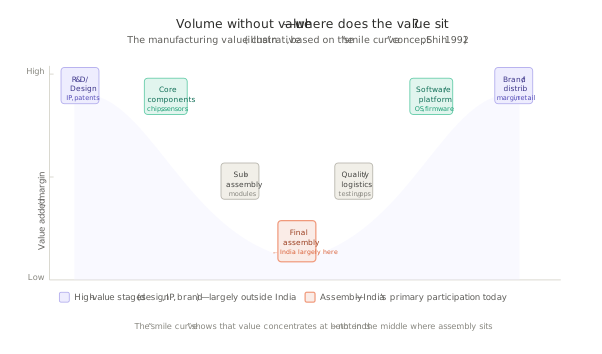
India is now among the largest manufacturing economies in the world by output. That is meaningful progress. It deserves recognition. But output alone does not answer the more important question: where does the value sit?
Take mobile phones. India assembles millions of them every year, over 30 million units in FY2023-24 alone, making India the world’s second largest mobile phone producer by volume (India Cellular and Electronics Association). This creates employment, strengthens process discipline, and builds scale. But the highest-value layers largely sit elsewhere. The chips, display modules, camera optics, sensors, core firmware, operating systems, and much of the production equipment originate outside India. The country participates in the manufacturing chain, but it does not yet control enough of the economic and technological value inside it.
The country that assembles the phone does not necessarily own the economics of the phone.
Assembly is useful. It is not sufficient. The deeper prize lies in components, capital equipment, original product architecture, and intellectual property. That is where margins are stronger. That is where know-how compounds. That is where strategic leverage sits.
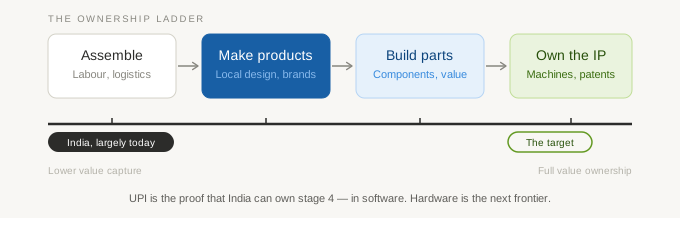
A country does not achieve industrial sovereignty by assembling someone else’s product, from someone else’s parts, on machines imported from somewhere else. It achieves sovereignty by owning progressively more of what makes the product possible.
The Competitor Who Must Not Be Named
India’s biggest competitor in manufacturing is not always a foreign country or a global conglomerate. It is inertia.
It is the quiet belief that things have always been done a certain way, and therefore need not be done differently now. This belief lives in vendor negotiations, in the reluctance to invest in tighter process control, in casual attitudes toward documentation, in logistics systems that treat precision-engineered parts like generic cargo, and in manufacturers who prefer familiar methods even when those methods are no longer enough.
This is not a talent problem. India has extraordinary engineers, machinists, operators, and entrepreneurs. It is an incentive problem. For decades, much of the ecosystem has been rewarded for reducing cost, not for building capability; for fulfilling orders, not for helping create categories; for staying safe, not for stretching into higher-precision work.
The services economy filled a large part of this vacuum. India became world-class in IT services, finance operations, legal services, recruitment, compliance, and business-process support. These are real strengths. But physical product building requires a different muscle. It requires people who define the problem, write the specification, design the system, file the patent, build the supply chain, and own the commercial outcome.
That shift is beginning. But it is far from complete.
The Market India Has to Invent
China solved part of its domestic manufacturing challenge by creating protected demand in key sectors, allowing local capability to mature before being exposed to full global competition. India cannot replicate that route cleanly, and perhaps should not. But the underlying question remains urgent: how does India create a durable market for Indian-designed, Indian-made hardware when imported alternatives are often cheaper, faster, and backed by more mature ecosystems?
There is no single answer yet. Production-linked incentive schemes help. Government procurement preferences help. Strategic sectors such as defence and space help. But these mechanisms alone cannot create a broad culture of product ownership across consumer and industrial hardware.
India needs commercially compelling products that are not merely “made in India” at the assembly level, but conceived from Indian problems, engineered from first principles, and good enough to earn demand without patriotic discounts.
UPI offers a useful reference point. It did not succeed because it was Indian. It succeeded because it solved a real Indian problem with extraordinary clarity, interoperability, and scale. It created a new behavioural default. By FY2024-25, UPI was processing over 172 billion transactions annually, accounting for roughly 46% of all real-time payment transactions globally (NPCI/ ACI Worldwide). Hardware needs its own equivalent. Not a copy of UPI, but the same level of ambition: products and systems where India is not merely the executor, but the originator of the category logic.
What It Actually Costs to Build to German Standards Without German Infrastructure
When an Indian hardware company attempts to build to global standards, it often finds itself doing two jobs at once. The visible job is building the product. The invisible job is recreating portions of the industrial ecosystem that should already exist around it.
This means developing vendors rather than simply selecting them. It means building internal test rigs that should be available as external services. It means performing tighter incoming quality checks because supplier consistency cannot always be assumed. It means redesigning parts around domestic manufacturability, holding more inventory because reliability is uncertain, and spending disproportionate time on documentation, traceability, and revision discipline.
A premium hardware company in India does not bear only product-development cost. It bears ecosystem-development cost. This is the tax on ambition.
A German company benefits from German industrial depth. A Japanese company benefits from Japanese supplier maturity. An Indian company aiming for the same product standard often has to subsidize the capability gap itself. That is why serious hardware building in India can appear slower and more expensive than outsiders expect. The product is not the only thing being built. The enabling industrial layer is being built in parallel.
What Is Being Done, and Why It Matters More Than It Looks
Despite these constraints, something important is shifting. Defence startups are indigenizing systems once assumed to be permanently import-dependent. Space-tech companies are producing sophisticated hardware in Bengaluru and Hyderabad. Semiconductor design firms are generating Indian intellectual property even when fabrication still happens offshore. Electric vehicle companies are pushing suppliers to move faster than they are comfortable moving, and under that pressure, some of those suppliers are beginning to evolve.
These companies share a common method. They are not merely consuming the ecosystem. They are upgrading it through demand.
Every time a demanding Indian customer asks a vendor to hold a tighter tolerance, document a process, improve a finish, shorten a lead time, or build a more reliable component, the ecosystem shifts slightly upward. That improvement does not disappear after one order. It becomes embedded in the vendor’s capability. The next hardware company inherits a marginally better industrial environment than the one before it.
This is slow compounding. But it is compounding.
What India Actually Needs to Build
Support
E: social@mankomb.com
M: 9739243943 (9am-5pm)
Connect
Connect. Follow. Stay connected
Copyright © 2025 | Mankomb Technologies | All Rights Reserved