AS FEATURED ON SHARK TANK INDIA

India's New Wet Waste Rules, Explained: What Every Urban Household Needs to Know
If you live in an apartment or a busy neighbourhood, you've probably seen the new notices about waste segregation going up on your society notice board or heard of the same through a buzz of notifications from that one WhatsApp group. India's Solid Waste Management (SWM) Rules, 2026 are now in effect and they come with stricter segregation requirements, composting obligations, and real penalties for non-compliance. This post breaks down exactly what the rules say, what counts as "wet waste," how composting fits in, and what Bengaluru residents in particular need to know.
Rushali Mariam Cherian
5/8/20268 min read
What Are the SWM Rules, 2026?
India's Ministry of Environment, Forest and Climate Change (MOEFCC) has issued the new Solid Waste Management (SWM) Rules, 2026, which replaced the earlier 2016 framework. The new rules were enforced from April 1, 2026, and apply to every waste generator such as households, residential societies, offices, commercial establishments, and governing authorities.
The single biggest change is the shift from a two-stream segregation system to a mandatory four-stream segregation system. Until now, most cities relied on a two-bin model (wet and dry). The new rules add two more categories, making the system more precise about what goes where.
The Four Bins: What Goes Where
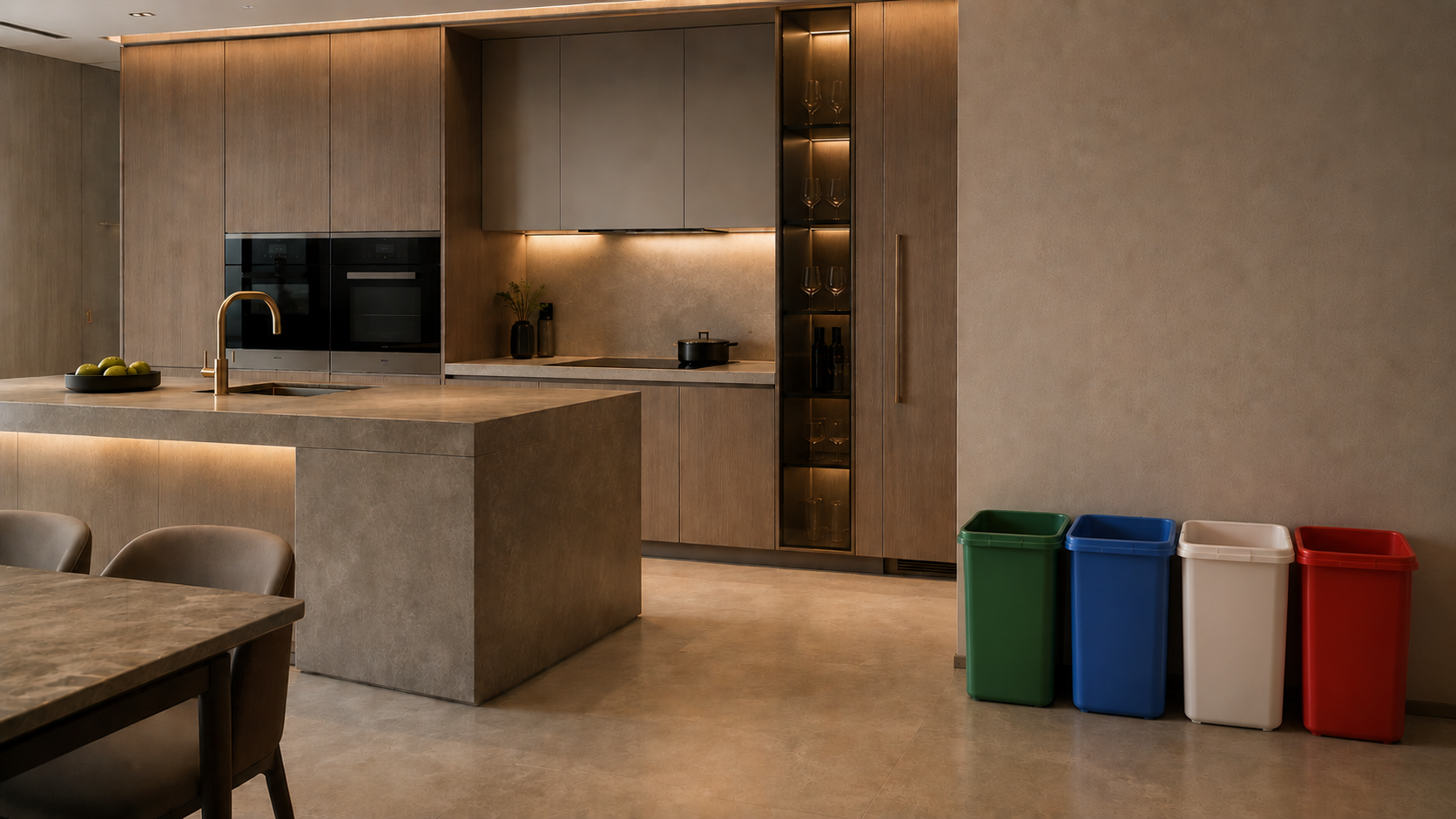
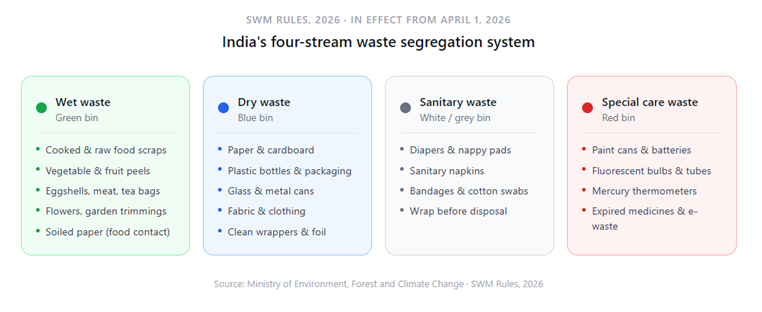
Here is how the four streams are defined under the new rules:
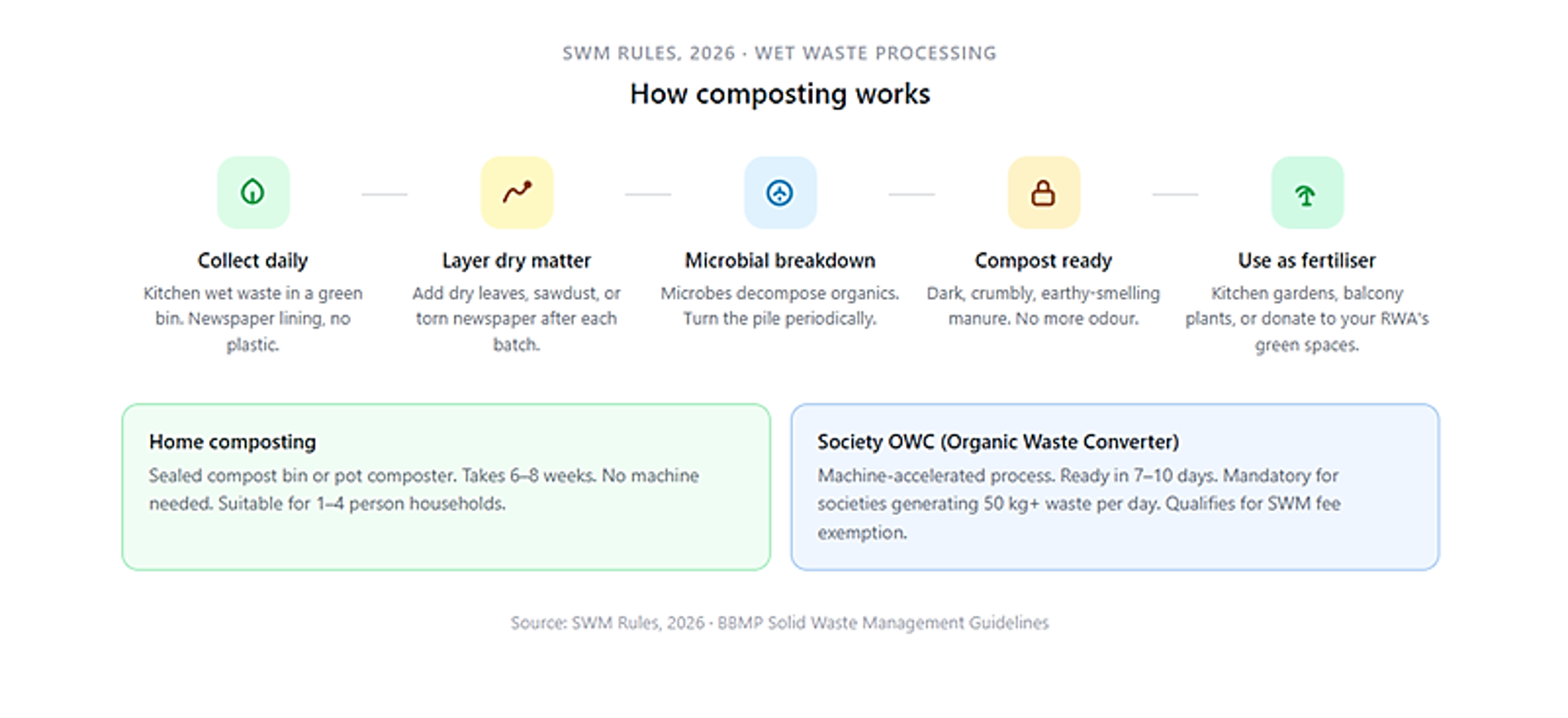
Under the SWM Rules, 2026, wet waste must be composted or processed through bio-methanation wherever feasible. For most urban households, this would mean managing their wet waste individually.
Home composting involves collecting wet waste in a sealed container or compost bin, layering it with dry matter such as dry leaves, newspaper, or sawdust, and allowing microbial action to break it down over 6-8 weeks into nutrient-rich compost. The result can be used directly in kitchen gardens or balcony plants.
Community or society-level composting uses Organic Waste Converters (OWCs). These are essentially machines that accelerate the breakdown process. A standard OWC can convert wet waste into manure in 7–10 days. Residential societies that generate more than 50 kg of waste per day are required to install and operate an OWC or equivalent on-site.
For societies that compost successfully and route dry waste to authorised recyclers, there is a significant benefit: exemption from the SWM service fee charged by the urban local body. They can apply for an exemption from the SWM fee thus providing a direct financial incentive for societies to invest in OWCs.
Rules Specific to Bengaluru (GBA)
Bengaluru's civic authority, previously the Bruhat Bengaluru Mahanagara Palike (BBMP), has been one of India's more active enforcers of waste segregation rules, and the 2026 framework strengthens the regulations that were already in place.
Households in Bengaluru: Every household must hand over waste already segregated into the appropriate streams. The collection vehicles have separate compartments for wet and dry waste. If you hand over mixed waste, the collection vehicle is authorised to refuse pickup. The responsibility to segregate the waste is entirely on the generator and not on the worker at your gate or at the facility.
Bulk Waste Generators (BWGs) in Bengaluru: Under BBMP's 2025-26 framework, BWG classification differs by property type. For residential properties: a property qualifies if it has 100 or more apartment units, or generates 100 kg or more of solid waste per day (BBMP circular, 2022). For commercial and industrial properties: additional criteria include a floor area of 20,000 sq. metres or more, or water consumption of 40,000 litres per day or more (SWM Rules 2026). Most mid-to-large apartment complexes fall into the residential BWG category.
A 400-unit apartment complex can generate about hundreds of kilograms of wet waste every single day.
BWG properties in Bengaluru now operate under a per-kilogram pricing model for wet waste, replacing the previous fixed annual charge. And once penalties increase, communities will increasingly optimize for three things:
Lower waste handling costs
Lower operational friction
Lower compliance risk
If a BWG property manages its own wet waste and routes dry waste through appropriate recyclers, it can apply for an exemption from the SWM fee.
This changes how waste solutions are evaluated. Earlier, sustainability products were treated like moral purchases. Now they are increasingly infrastructure purchases.
Closer to air purifiers, water softeners, or backup power systems. Not symbolic. Functional.
The Polluter Pays Principle Is No Longer Abstract
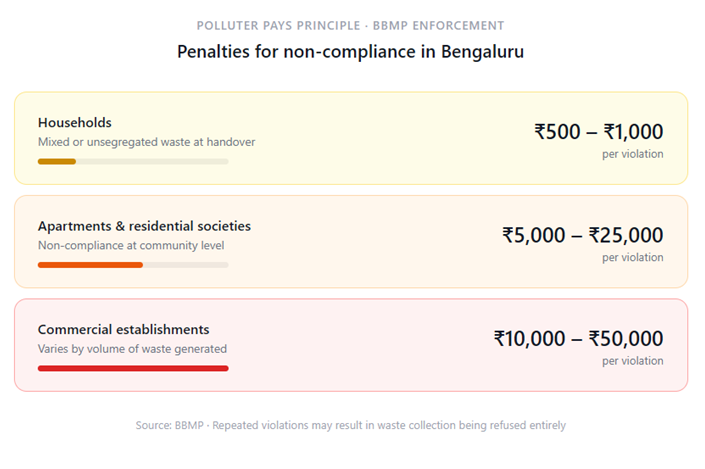
SWM Rules, 2026 operate under the "polluter pays" principle and non-compliance attracts environmental compensation. In Bengaluru, the penalty structure is as follows:
Households: ₹500 to ₹1,000 per violation for handing over mixed or unsegregated waste.
Apartments and residential societies: ₹5,000 to ₹25,000 per violation.
Commercial establishments: ₹10,000 to ₹50,000 depending on the volume of waste generated.
Beyond fines, repeated non-compliance can result in waste collection being denied entirely which, opens a completely different can of worms for housing societies and their residents.
Bengaluru has already seen what happens when frustration around waste reaches a tipping point.
One of the city’s most memorable civic protests was the “Kasa Surisuva Habba” initiative, loosely translated as “festival of dumping garbage.”
The movement emerged during periods of severe waste-management breakdowns in the city, when residents protested illegal dumping and poor municipal handling. This was tackled by returning the garbage to the respective individuals, authorities or establishments. What made the campaign resonate was not just the spectacle by itself, but the message:
Waste does not disappear just because it leaves your threshold.
The Four-Bin Rule Is Really About One Thing
The headlines focus on the number of bins. Green, blue, red and black. But the shift is more behavioural.
India is slowly moving from centralized dumping toward decentralized accountability.
The government’s revised rules also include phased implementation timelines because cities require time to upgrade current collection systems, improve transport infrastructure, and overhaul disposal mechanisms. Reports on implementation reference transition periods ranging from six months to longer phased adoption windows depending on local bodies and operational readiness.
That gap between policy and infrastructure is where most urban frustration currently sits. People are being asked to participate in systems that are still evolving.
But this transition phase also reveals something important:
The most future-ready homes will not be the ones waiting for perfect municipal infrastructure. They will be the ones reducing dependence on it altogether.
What You Should Do Now
If you haven't already, here is a practical starting checklist for urban households:
Set up three or four bins at home: A small wet waste bin lined with newspaper, not plastic, a dry waste bin, and a bag or container for sanitary and hazardous items.
Empty the wet waste bin daily or at least every alternate day: Wet waste left for more than two days begins to smell and attract pests.
Consider an on-site wet waste solution. Chewie is an AI-powered appliance designed for urban Indian kitchens with no manual stirring, no odour, no pest risk. It converts your wet waste into Regen Soil automatically. Traditional home composting systems are also available for households that prefer a manual approach. BBMP has offered subsidies in the past for residents who adopt on-site composting; check with your ward office for current schemes.
For society residents, check if your RWA has an OWC: If not, raise it at your next general body meeting. The exemption from SWM fees can offset the installation cost within a year for most mid-size societies.
Do not put wet waste in plastic bags: Use newspaper, compostable bags, or, no liner at all. Plastic liners defeat the purpose of wet waste segregation and often end up as a contaminant in large composting facilities.
India's SWM Rules, 2026, represent the most significant update to waste management law in a decade. For urban households, your responsibility is clear: separate your wet waste from everything else, and hand it over in a condition that allows it to be composted. The four-bin system is now being enforced, penalties are being levied, and cities like Bengaluru have both the enforcement infrastructure and the financial incentives in place to make compliance the norm rather than the exception.
“Bin There, Dump That” Only Works If There’s Somewhere to Dump
India’s waste conversation still assumes that waste is someone else’s responsibility. Someone else will collect it, sort it, process it and dump it somewhere outside the city.
But everyone seems to ignore a harsh truth: every city is running out of “somewhere else.”
Landfills are politically volatile. Transport costs are rising. Segregation enforcement is increasing because municipalities cannot sustain mixed waste streams indefinitely.
So how does that change the role of the modern kitchen? The kitchen is no longer just where waste begins. Increasingly, it is also where waste must end.
The households that will suffer least under stricter waste enforcement are the ones least dependent on municipal systems.
1 Penalty amounts cited are based on BBMP’s published bye-laws and documented enforcement actions. These are Bengaluru-specific rates; the SWM Rules 2026 delegate exact fine-setting to State Pollution Control Boards, so amounts may differ in other cities and are subject to revision. Verify current rates at bbmp.gov.in or with your local ward office before publishing
2 For the latest updates on BBMP waste rules and composting subsidies, check the BBMP official website or your ward office.
Wet waste (green bin) - Kitchen and organic waste. This includes cooked and uncooked food, vegetable and fruit peels, meat, eggshells, flowers, garden trimmings, and tea leaves. Anything that was once biological and will decompose. This stream is routed to composting, bio-methanation facilities, or perhaps, Chewie.
Dry waste (blue bin) - Recyclable materials that are clean and dry. Paper, cardboard, plastic bottles, glass, metal cans, and fabric. These go to Material Recovery Facilities (MRFs) where they are sorted and sent to recyclers.
Sanitary waste (white or grey bin) - Used diapers, sanitary napkins, bandages, and similar hygiene products. These must be wrapped separately before disposal and are not mixed with wet or dry waste.
Special care waste (red bin) - Hazardous household items such as paint cans, fluorescent bulbs, mercury thermometers, expired medicines, batteries, and electronic waste. These are collected at designated drop-off centres.
On paper, this makes perfect sense. It is the right thing to do. You’re adhering to the rules, respectful of people working in the facilities and stand on moral ground that you are doing the best you can for the environment. But in practice, the friction of segregation starts immediately.
In a household that runs on schedules such as school runs, early calls and domestic staff rotations, waste segregation is one more system that needs to work without thought. Collection timings shift. A family member uses the wrong bin. By 9 AM, the kitchen already feels like it's failing a compliance audit.
And then comes the question almost everyone quietly asks: If the collection truck still mixes some of it later, why am I doing all this? Would mixing the wet and dry waste together get noticed? Would today be the day my waste is rejected and I get fined?
Urban professionals really do live life on the edge. But, the direction of this policy is also clear.
Cities are steadily moving toward decentralized accountability because centralized mixed-waste handling has failed repeatedly. The burden is slowly shifting upstream, toward homes and communities.
What Exactly Counts as Wet Waste?
Wet waste is the largest contributor by volume in most Indian households, and also the most likely to cause problems if handled incorrectly.
Wet waste includes:
Raw and cooked food scraps
Vegetable and fruit peels and seeds
Leftover cooked food (dal, rice, roti, curries)
Eggshells and meat scraps
Tea bags and coffee grounds
Flowers and plant trimmings from home gardens
Soiled paper (paper used to wipe food)
Wet waste does not include:
Oily food wrappers or plastic packaging (these go in dry waste)
Sanitary products (separate bin)
Broken crockery or glass (special care waste)
The key test is simple: if it was once organic and will rot, it is wet waste.
Why Segregation at Source Matters
The new rules place legal responsibility rightly on the waste generator meaning you, as a household. The principle applied is "polluter pays": if you hand over unsegregated waste, you are responsible for the downstream cost and harm that causes.
When wet and dry waste are mixed together, several things go wrong. Recyclable materials get contaminated and cannot be processed any further. Organic waste generates methane in landfills, a greenhouse gas far more potent than CO₂. Processing costs for urban local bodies go up significantly. And landfills, that are already overfull in most Indian cities, fill up even faster, flashing glimpses of a possible Wall-E future.
Segregating waste at home is the one of the most impactful and environment friendly steps an urban household can take.
How Does Composting Work and What Do the Rules Mandate?
Support
E: social@mankomb.com
M: 9739243943 (9am-5pm)
Connect
Connect. Follow. Stay connected
Copyright © 2025 | Mankomb Technologies | All Rights Reserved