AS FEATURED ON SHARK TANK INDIA

Your Kitchen Bin Is More Expensive Than You Think
A dustbin is probably the cheapest object in your kitchen. But it may also be the one thing that quietly demands the most attention in your house.
Rushali Mariam & Dinesh Babu Sukumar
7/2/202610 min read

A dustbin is probably the cheapest object in your kitchen. But it may also be the one thing that quietly demands the most attention in your house.
Consider the cost: somewhere between ₹500 and ₹1,500, depending on how serious you are about aesthetics. You pick it up at the store with barely any thought. You place it under the sink, or in the corner of the kitchen, and you consider the matter closed. The bin is handled. You move on to the more interesting decisions: the air fryer, the water purifier, the induction cooktop.
But the bin is never really handled.
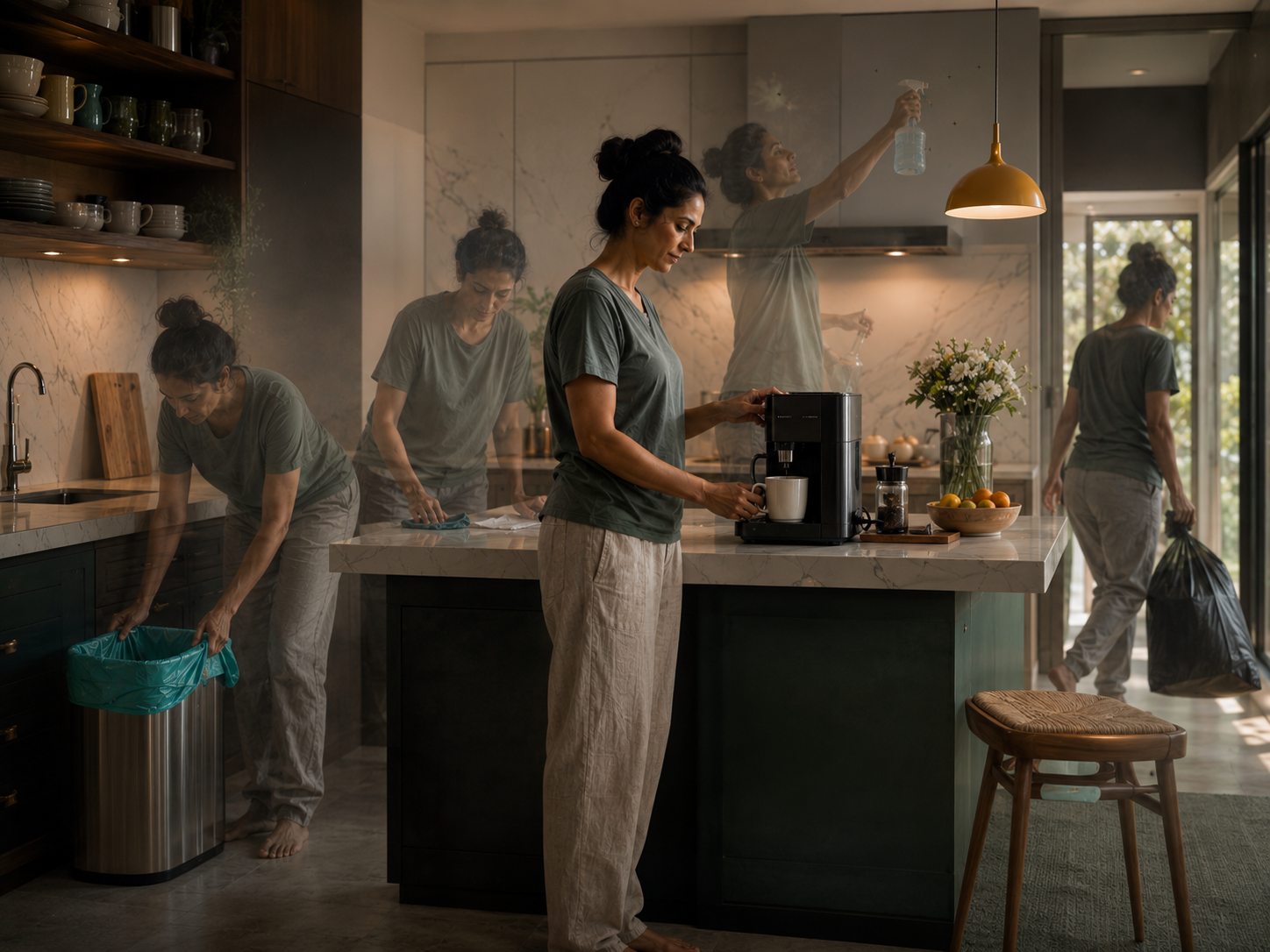
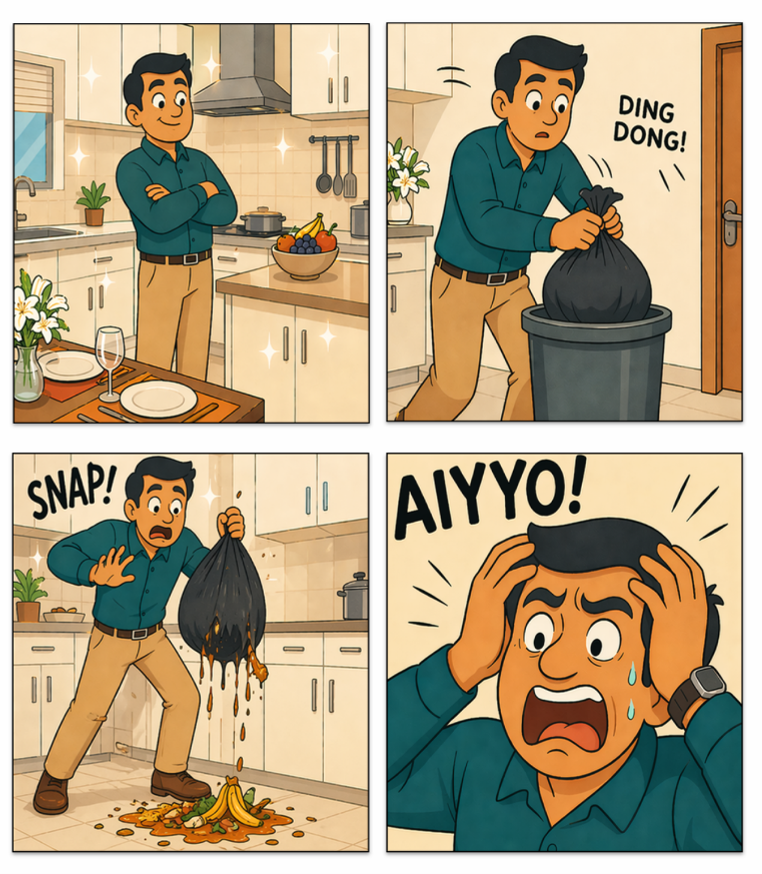
It is Monday morning. The coffee is brewing. Breakfast is wrapping up. The children are getting their bags. Someone remembers, from the “moving” speakers outside, that the trash needs to be taken out. Someone else notices the weird smell that arrived overnight. The liner has leaked. The fruit flies that disappeared last week are back. The househelp has not come today, which means someone is dealing with a wet bag of yesterday's food in a building corridor at seven-thirty in the morning, in work clothes, before the actual day has started.
Nothing dramatic happened. No appliance broke. No crisis occurred. And yet we can all relate, because they have lived this exact sequence, or some version of it, more times than they can count.
Here is the question that sequence raises: How did a ₹500 plastic container become one of the most demanding systems in the modern home?
The Workflow We Never Agreed to Buy
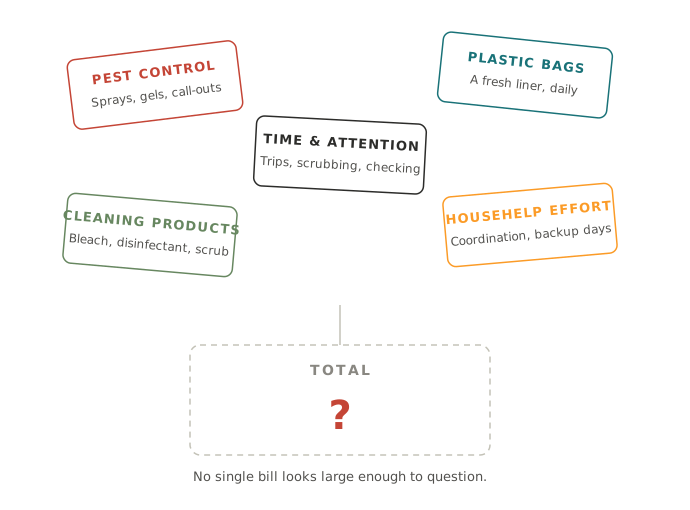
Plastic bags- Most households buy liners without thinking about the annual bill. A single liner per day, at roughly ₹7 to ₹8 each, runs the math to somewhere around ₹2,700 per year. That number sounds modest until you consider what it is purchasing: a daily envelope for wet waste that mostly consists of water. The bag exists not because it solves the problem of wet waste but because it contains the problem of wet waste long enough for someone to carry it somewhere else. It is the most widely accepted non-solution in the modern kitchen, and every household in the country buys it without batting an eyelid.
Cleaning products- Why do you buy air fresheners? Why bleach? Why disinfectant, floor cleaner, and scrub pads? The honest answer, in most cases, is the bin. Not entirely, perhaps, but substantially. The products exist because wet waste generates smell, moisture, and bacteria at a steady rate, and because these byproducts escape the bin into the surrounding area. A conservative estimate for a family of four is ₹100 to ₹120 per month in cleaning supplies attributable to wet waste management. That is ₹1,400 per year to make the kitchen feel like a kitchen rather than a disposal site.
Pest control- Here is where the biology becomes relevant. Wet waste is rich in moisture, sugar, starch, oil, and food residue. For fruit flies, cockroaches, ants, and in some cases rodents, this is not garbage. It is a food source, precisely the kind that is moist, warm, and reliable. Every banana peel, leftover curry, coffee ground, and fish bone joins the supply chain, and the longer wet waste sits inside the home, the more hospitable the kitchen becomes to pests that were not invited.
A fruit fly can detect fermentation from several hundred metres away and locate it within hours. A single female lays up to five hundred eggs in her lifetime, and the cycle from egg to adult takes roughly eight days under warm conditions. The kitchen in an Indian apartment during summer, with a bin that holds two days of food scraps, is close to optimal breeding territory. This is not a hygiene failure. It is nature operating exactly as it was meant to, responding to an invitation the bin extends daily.
Most families do not connect their pest control bills to their kitchen bin. A typical urban home spends around ₹5,000 per year on pest control treatments, including sprays, gels, professional call-outs, and the various products available at every pharmacy. Wet waste is rarely the sole cause, but it is consistently one of the biggest triggers. The bin does not solve the pest problem. It creates the conditions for it.
Time- Imagine someone asked you, formally, to spend two full working days every year carrying bags of food scraps from your kitchen to the disposal point. Would you agree to that? Would you sign up, in writing, to repeat this task 365 times?
Three minutes per day adds up to over eighteen hours per year for daily waste trips alone. Add another seventeen-plus hours for bin cleaning, scrubbing, mopping the area under the sink, and managing the leaks and spills that are an ordinary feature of wet waste management. That is thirty-six hours of visible effort per year, before accounting for the time lost on days when the system fails: the househelp misses a day, the garbage collection is delayed, the bag tears on the way out, the pest problem requires an emergency intervention.
Mental load- There is a running background checklist that wet waste creates in the mind of whoever manages the household. Did we change the liner? Is the bin starting to smell? Will the flies be back by evening? Did the househelp take it out or just assume? Is today the dry waste pickup or the wet waste one? Has the society collection been delayed again? Is the area under the sink clean enough for guests?
None of these questions are demanding in isolation. Together, and repeated daily, they represent cognitive load: the ongoing consumption of mental bandwidth by small, recurring decisions and checks. Research on bounded rationality established that human decision-making capacity is not infinite. Every micro-decision about waste management is one less unit of attention available for something else. The best-designed systems eliminate decisions. They do not generate new ones. The kitchen bin generates new ones every day.
When you add this up, across a family of four, the real annual cost of a standard kitchen bin is not ₹500 or ₹1,500.
It is closer to ₹9,100 to ₹20,000 per year, once you count the liners, the pest control, the cleaning products, the househelp-linked effort, the time cost of daily disposal, the cleaning hours, and the mental overhead.
The Chores That Disappeared
When you brought the bin home, you thought you were buying just another dustbin. But what you actually purchased was a workflow.
The bin, left to its own logic, requires someone to remember the liner change before the smell sets in. It requires someone to carry the bag out without it leaking through the corridor. It requires cleaning, twice a week minimum, because wet food residue does not wait politely. It requires replacing liners daily, coordinating with the househelp, tracking pickup schedules, managing pest cycles, restocking disinfectant, and maintaining a baseline of hygiene that takes genuine, repetitive effort.
The bin is not passive. It recruits every adult in the household into low-grade maintenance labour that nobody planned for when they made the purchase.
There is a term in economics for this category of work: invisible labour. It describes the tasks that keep a household running but never appear on any schedule, never get credited, and are noticed almost exclusively when they are not done. Arlie Hochschild, in her book, “The Time Bind”, writes about the division of domestic work, describing how a household runs on a vast infrastructure of small, repeated decisions and actions that fall outside anyone's formal accounting of their time. Wet waste management sits squarely inside that category. It happens every day, demands cognitive space, and carries a surprisingly high cost when anyone bothers to calculate it.
Most people never bother. The bin looks inexpensive because its costs scatter across other line items: the pest control invoice, the cleaning products picked up at the supermarket, the househelp wages. No single charge feels large. The total is never assembled. And because the total is never assembled, the assumption persists that the bin is a trivial object with a trivial cost.
That assumption is wrong.
The Audit Nobody Runs
Let us find out what your bin actually costs:
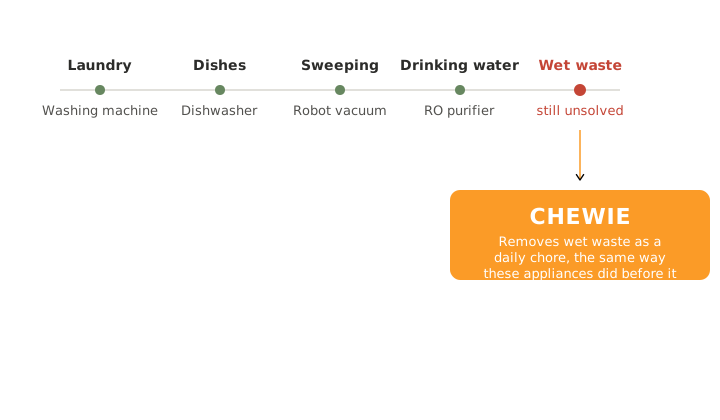
Why do we not wash clothes by hand anymore? Because washing machines arrived and made hand-washing unnecessary. Why do we not wash dishes manually in most households that can afford not to? Because dishwashers exist. Why do we not sweep daily with a broom? Because robot vacuums do it without being asked.
Notice the pattern. In every case, the technology did not persuade people to love the chore. It eliminated the chore. The washing machine did not make laundry feel more satisfying. It made laundry irrelevant. The dishwasher did not improve anyone's technique. It removed effort from the equation entirely.
Convenience does not change how people feel about tedious tasks. It removes tedious tasks from the environment.
This is what scientists mean when they discuss friction. Every chore that remains in the home exists because the friction of doing it has not yet been low enough to redesign away. When friction drops to near zero, behaviour changes permanently. Nobody who has owned a dishwasher for six months chooses to go back to hand-washing because they miss the ritual.
Wet waste management has survived this wave of redesign for one reason: nobody built the machine that made it unnecessary.
Every banana peel, leftover curry, and coffee ground joins more than 170,000 tonnes of municipal waste generated each day across India. Most of it begins exactly where yours did: in a kitchen, in a bin that stores the problem rather than solving it.
The System Was Built to Answer the Wrong Question
The bin was designed to answer one question: where does the waste go for now? The answer it gave was: here, under the sink, until someone takes it away.
That answer made sense in a world where household labour was abundant, organic waste was simple to manage outdoors, and no alternative existed. It is a less sensible answer in a world where kitchens are designed for hygiene, pest control is a recurring household expense, and time is the most protected resource in affluent households.
Here is the sharper way to frame the problem. The refrigerator did not ask you to store your food in a corner until you could find a cold place. It solved the temperature problem inside your home. The washing machine did not ask you to find a river. It solved the laundry problem inside your home. The kitchen bin asks you to store wet waste inside your home until the external infrastructure of municipal collection handles it.
The bin is a waiting room for waste. It does not process anything. It defers the problem by twenty-four hours, and in exchange for that deferral, it charges you in odour, pests, liner costs, cleaning hours, househelp dependency, and cognitive overhead every day of every year.
The Infrastructure That Already Replaced Inconvenience
Look at the infrastructure already running inside a q modern apartment in Indiranagar or Whitefield.
There is an RO water purifier, because tap water was inconvenient to trust. There is an air purifier, because poor air quality was inconvenient to accept. There is an air conditioner, because heat was inconvenient. There is an inverter, because power cuts were inconvenient. There is a smart lock, because physical keys were inconvenient. There is a robot vacuum, because daily sweeping was inconvenient. There is a dishwasher, because hand-washing was inconvenient.
Each of these devices exists because at some point, a household in this income tier decided that a specific inconvenience was no longer acceptable. The decision was not philosophical. It was practical. The technology arrived, the problem was solved, and the behaviour changed permanently.
Wet waste is the next system in this sequence. Chewie is being built for exactly this shift- the appliance designed to make wet waste the next chore that quietly disappears from the kitchen.
It is already the last major daily household task that runs entirely on manual effort, third-party dependency, and repeated inconvenience. It requires physical action, generates ongoing hygiene risk, demands daily coordination, and carries a cost that most households have simply never added up.
The Question the Next Generation Will Ask
Imagine a child, ten or fifteen years from now, visiting an older relative's kitchen. The relative still has a bin under the sink, still changes the liner every day, still coordinates with the househelp on collection schedules.
The child asks: Why did people keep rotting food under the sink?
The question will sound strange. It will sound like asking why people washed clothes in rivers, or stored ice blocks before refrigerators existed, or went outside for drinking water before plumbing arrived. The answer, in each case, is the same: because no better solution existed yet.
But the better solution always arrived. And once it arrived, the old behaviour stopped looking like a reasonable choice. It started looking like what it was: an inconvenience that was accepted for as long as it had to be, and abandoned the moment it no longer had to be.
The kitchen bin will go the same way. Not because of an environmental argument, though the environmental case is real. Not because of a hygiene argument, though the hygiene case is compelling. But because at some point, the households that can see the full cost of living with a bin, roughly ₹10,000 to ₹20,000 per year in cash, time, and cognitive overhead, will decide that the cost is not worth paying.
The question is not how much a bin costs to buy. It is why the modern kitchen still has one at all.
What the Bin Actually Reveals
The real subject of this article was never the bin.
The bin reveals something larger: that the most expensive things in a household are often the ones that look cheap at purchase. The bin reveals how invisible labour gets distributed, how cognitive load accumulates without ever appearing on a budget, how product design failures persist because the alternatives take time to arrive, and how convenience, once it appears, permanently rewrites what people are willing to accept.
Every home that invested in a washing machine did not become more disciplined about laundry. It stopped doing laundry the hard way. Every home that invested in an air purifier did not develop stronger lungs. It stopped tolerating dirty air.
The household that eliminates wet waste management as a daily task does not become more organised, more sustainable, or more virtuous. It simply stops spending ₹10,000 to ₹20,000 per year on a problem that has a better solution.
The bin is cheap. Living with it is not.
Support
E: social@mankomb.com
M: 9739243943 (9am-5pm)
Connect
Connect. Follow. Stay connected
Copyright © 2025 | Mankomb Technologies | All Rights Reserved