AS FEATURED ON SHARK TANK INDIA

The Circular Home: What Zero-Waste Living Could Actually Look Like
In the 1900s, a housewife spent approximately fifty-eight hours a week on household chores. By 1975, after the widespread adoption of washing machines, refrigerators, and dishwashers, that number had dropped to roughly twenty-six hours. The most significant driver of that reduction was not a cultural shift in attitudes toward housework. It was the pursuit of efficiency. Somebody built a machine that did the job automatically, and quietly, in the background, while the household got on with living. This brings us to the obvious question: if history looks like this, what is the next chapter?
Rushali Mariam & Dinesh Babu Sukumar
5/21/202610 min read
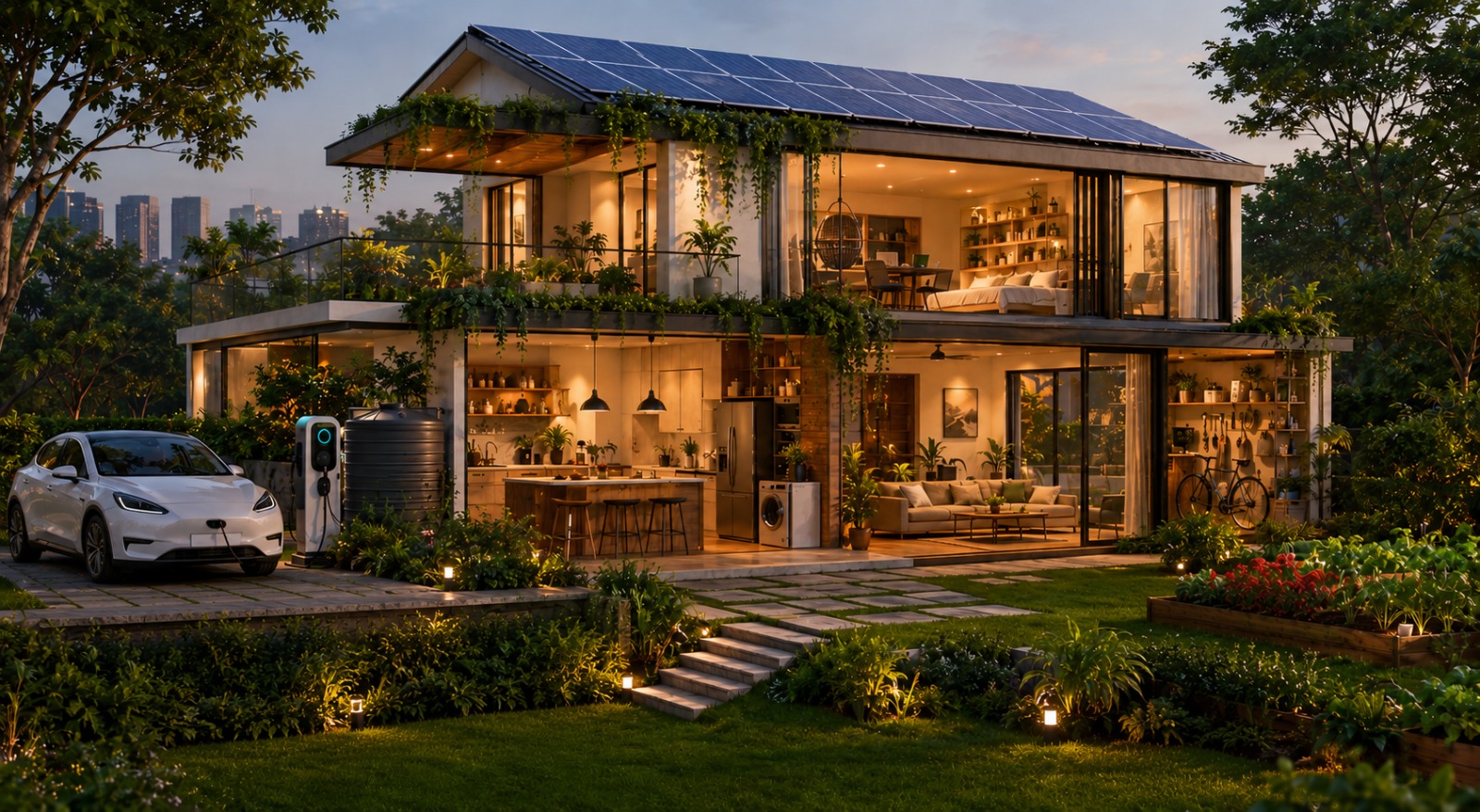
The real history of the modern home is not a story of architecture or aesthetics but of progressive automation of household chores. Each generation inherited a home that did more work with less human effort than the one before it. Laundry moved from the river to a small tub to a plug-in appliance. Food moved from daily market trips to a cold-storage unit that lasted a week. Cleaning moved from brooms to vacuums to robomops that navigate rooms on their own.
The pattern is consistent: identify an inconvenient task, engineer a system that removes the daily effort, and the household adopts it without much persuasion. Nobody debated whether to buy a refrigerator on ecological grounds. They bought it because carrying ice was tedious.
Circularity Is Not a New Idea
Before the linear economy (extract, consume, and discard model) most households were already circular. Many households in earlier generations were already practicing sustainability, even if they never used that word.
Food scraps fed animals or returned to the soil. Containers were repaired before they were replaced. Clothes were repurposed into rags, then into stuffing, then into nothing. Water from cooking vegetables was used to water plants. The Japanese concept of “mottainai”, roughly translated as "what a waste", captured a whole philosophy of regret around discarding anything that still held value. In Indian households, the same instinct lived in different language: the steel dabba that lasted four decades, the pressure cooker bought in 1987 that still functions, the practice of repurposing rather than replacing. The circular home, in that sense, is not an invention but is a rediscovery.
What changed was urbanisation. Apartment living removed backyard composting. Nuclear households replaced extended families who distributed resources and labour across generations. Convenience packaging grew because the infrastructure for packaging waste did not. Municipal systems were designed to absorb the consequences of linear consumption, and for a while they managed. But now they are unable to withstand the same.
The interesting question is not how to persuade modern households to return to the circular instincts of their grandparents. The question is: what would those instincts look like if they were rebuilt into modern infrastructure, at the same level of convenience people currently expect from refrigerators, inverters, and hot-water geysers?
Why Does Sustainability "fail"?
The Energy Loop
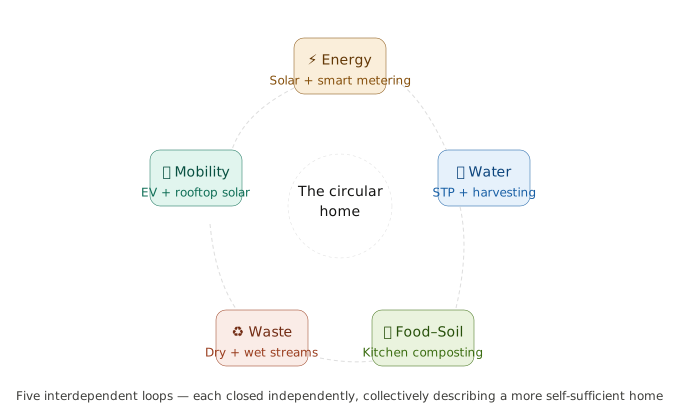
Energy enters the home, powers appliances, and is either used efficiently or wasted. In the circular home, rooftop solar offsets grid dependence. Battery backup maintains continuity without diesel. Smart metering identifies consumption patterns. Load management prioritises essential systems. The goal is not complete self-sufficiency. It is reduced dependence and reduced waste. In Indian cities where grid power remains unreliable, energy circularity is not idealism. It is a practical response to a structural unreliability most urban households have already internalised.
The Mobility Loop
EV adoption among premium urban households is accelerating. The transition from petrol to electric is partly economic, partly environmental, and partly about status. Over a ten-year ownership horizon, the total cost differential increasingly favours electric. More meaningfully, the home and the vehicle become integrated systems: an EV charging in the basement overnight draws power from a solar system on the roof, closing a loop that a petrol car can never participate in.
The Water Loop
In Bengaluru, water circularity is not an aspirational concept. It is a requirement. The city's dependence on tanker water has grown as groundwater has significantly declined. Apartment complexes that built sewage treatment plants years ago are now discovering that treated water can irrigate landscaping, flush toilets, and supplement construction demand, dramatically reducing what they need to buy. Rainwater harvesting mandates exist on paper across most Indian urban jurisdictions. The homes that implement them seriously are now the most water-secure. Greywater reuse, efficient fixtures, and leak detection complete the loop.
The Waste Loop
Source segregation is necessary but not sufficient. Dry waste must remain dry and uncontaminated to be recyclable. Wet waste is the primary contaminant, because when it mixes with dry waste, it renders materials unrecyclable. Sanitary waste, e-waste, hazardous materials, and packaging each require separate channels. Communities that manage this well are beginning to qualify for significant exemptions under India's evolving solid waste management framework. The incentive structure is increasingly aligned with the behaviour required.
The Food-to-Soil Loop
This is the loop that most homes currently abandon entirely. Organic waste contains significant nutrient value such as nitrogen, phosphorus, potassium, and microbial diversity. When deposited in a landfill, it decomposes anaerobically, generating methane and leachate. When processed correctly, it returns those nutrients to soil in a form that supports plant health.
The kitchen is where the circular home either succeeds or fails. It is also where the most visible gap in domestic automation currently exists.
A Day Inside the Future Circular Home
A family lives in a high-rise apartment in a gated community. The building is ten years old, well-managed, and served by an STP that routes treated water to the landscaping and basement car wash. Solar panels on the terrace offset roughly forty percent of common-area electricity consumption. The basement has twelve EV charging points.
The husband leaves at seven-thirty. His car charged overnight. He does not think about it. The wife works from home three days a week and leaves on two. The children are in school by eight.
In the kitchen, the morning's vegetable peels from breakfast preparation go directly into Chewie. There is no separate bin. The dry waste such as cardboard, clean plastics, glass, etc. accumulates in a separate bag and goes out on collection day. The society has a dry-waste partnership with a recycler. The material is not contaminated because it never met the wet waste stream.
The apartment's smart meter monitors consumption. The air purifier has been running since six, triggered by the AQI reading from the nearest monitoring station. The water softener regenerated at two in the morning when the building's demand was lowest.
Nobody in the household made a decision about any of this. No habit was heroically maintained. No discipline was required as all systems in place simply ran.
Bengaluru as Preview
Bengaluru is often cited as India's “Silicon Valley”. It may also, inadvertently, be becoming its most instructive laboratory for circular-home thinking, not because its citizens are unusually environmentally conscious, but because its resource infrastructure has degraded far enough that households have begun building resilience themselves.
It is the same logic described in the conversation about power backup. When the grid becomes unreliable, people buy inverters. When municipal water supply becomes unreliable, people invest in borewells, and then in treatment systems when the borewells become brackish, and then in tankers, and then in rainwater harvesting when the tanker economics become punishing. When garbage collection becomes inconsistent, communities begin exploring on-site processing.
This is not environmental consciousness. It is self-interest expressed through infrastructure investment. And it produces outcomes that are better for the city than whatever the alternative was.
Bengaluru's apartment communities are now among the most sophisticated informal waste managers in India. RWAs in upscale areas in Whitefield and Indiranagar have built OWC systems, negotiated dry-waste contracts, and reduced their municipal dependence significantly. The motivation was rarely climate concern. It was usually a combination of regulatory pressure, rising costs, and the simple desire to not live next to a rotting pile of waste. The city, in that sense, is a preview. Not of what India will choose. But what India will be forced toward, and then eventually prefer.
The New Definition of Premium
For most of the twentieth century, premium residential living was a signal of accumulation. Larger floor plates, more expensive materials, higher staff ratios, and grander lobbies. The luxury home was understood primarily in terms of what it contained.
But that is shifting. The shift is most visible in how the world's most sophisticated residential markets are evolving.
In Singapore, luxury housing in newer developments is increasingly judged on energy independence, water management, and indoor air quality metrics alongside the traditional categories of finishes and location. In Scandinavian residential design, the premium signals are almost the inverse of the old model: absence of visible infrastructure, silence, reliability, and a home that imposes minimal operational demands on its residents. Net-zero luxury developments in California are now marketing their energy performance as a primary selling feature, not an afterthought. The transition can be described simply: old luxury was about more. New luxury is about better operations.
A premium home that produces no kitchen odour is more pleasant to inhabit than one that does. A home with water security is more resilient than one without it. A home that requires fewer trips to the municipality, fewer conversations with the RWA, fewer daily negotiations with broken downstream systems is a more comfortable home. These are not environmental arguments. They are quality-of-life arguments. The environmental consequence is real, but it is a byproduct of the primary benefit, which is simply living better.
What the Evidence Says About Scale
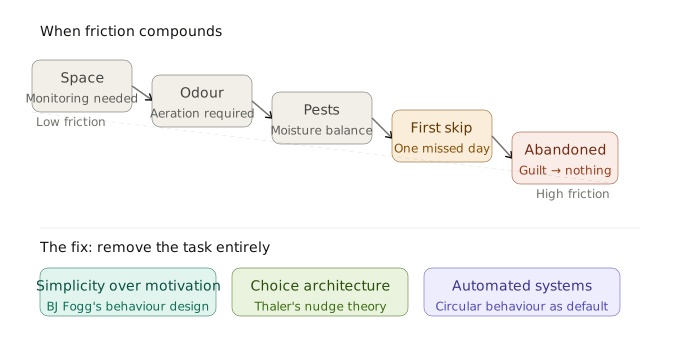
Behavioural economists have spent the better part of three decades documenting a consistent phenomenon: people rarely fail to act sustainably because they disagree with the goal. They fail because the behaviour is annoying.
Richard Thaler's work on nudge theory established that small changes in how choices are presented have a larger impact on behaviour than information, incentives, or appeals to values. And, BJ Fogg's behaviour design research concluded that the most reliable predictor of whether a person sustains a new habit is not motivation but simplicity.
This is how human cognition works under the conditions of modern urban life. A household managing a ten-hour workday, a school run, elderly parents, weekend commitments, and a rotating domestic help schedule does not have a surplus of time to be sustainable.
Composting is a perfect example. The evidence for its benefit is unambiguous. It diverts organic waste from landfills, reduces methane emissions, returns nutrients to soil. Awareness of those benefits is not the constraint. The constraint is that composting, done traditionally, requires space, monitoring, moisture management, aeration, and a tolerance for occasional pest and odour problems. Every one of those requirements is a friction cost. And friction compounds. The first skipped day becomes a skipped week becomes an abandoned bin becomes guilt becomes nothing.
Sustainability will not scale in India by asking households to become better waste managers. It will scale when systems remove waste management from the list of things households need to manage at all.
What Does an Ideal Circular Home Look Like?
The circular home is neither a hut nor a minimalist aesthetic exercise. It is a smarter, cleaner, more deliberately designed version of the modern urban home, one that treats resources as inputs to be used efficiently. It can be useful to think of the circular home through five distinct loops, each corresponding to a category of resource flow.


The most frequently cited example in circular-living discussions is Kamikatsu, a town of roughly fourteen hundred people in Tokushima Prefecture, Japan, which famously operates a forty-five-category waste sorting system and diverts close to eighty percent of its waste from landfills. Kamikatsu is instructive, but the lessons that travel are not the ones usually drawn from it.
The forty-five categories are not the point. The point is that Kamikatsu built physical infrastructure to facilitate the same. A centrally located resource centre where residents deposit their waste and are supported by people who can help with classification. That made the behaviour far less burdensome than the number of categories implies. The lesson is not "sort more." It is "design infrastructure that makes sorting easy enough to sustain."
South Korea's food waste policy reinforces this. Mandatory separation and volume-based charging, introduced incrementally from 2005 onward, achieved near-universal compliance within a decade, not because Korean households are unusually disciplined, but because the combination of price signals and improved collection infrastructure made compliance the path of least resistance. When circular behaviour is the easier option, circular behaviour scales.
The pattern is the same in every geography where circular systems have actually scaled. Systems work. Appeals to conscience do not. Infrastructure creates behaviour more reliably than awareness campaigns.
The Whole Truth
Complete zero-waste living is not currently possible for most urban Indian households, and it would be dishonest to suggest otherwise.
Modern urban life generates packaging waste from supply chains, e-waste from device replacement cycles, textile waste from changing consumption patterns, construction waste from maintenance and renovation, medical waste, and supply-chain emissions that households have no direct mechanism to address. Not all materials can be meaningfully recycled within local infrastructure. Not all consumption can be made circular through household-level choices.
The goal, honestly stated, is not absolute zero. It is a home that sends dramatically less waste outside, that treats the kitchen, the water system, and the energy infrastructure as loops rather than pipelines, and that reduces dependence on downstream systems that are already overloaded.
That goal is already achievable. It does not require heroic behaviour. It does not require the abandonment of comfort. It requires applying to waste the same logic that Indian urban households have already applied to power, water, and air: if the system outside is unreliable or inadequate, build the solution inside.
Tomorrow is Being Built Today
The circular Indian home is not a fantasy reserved for some future decade. It is a stack of technologies and habits that are already available, already being adopted by premium urban households, and already producing the outcomes the concept promises.
Solar is on more rooftops than it was five years ago. EVs are in more basements. STPs are treating more water. Dry-waste partnerships are diverting more material from landfills.
Each loop, when closed independently, produces a measurable improvement in how the home operates. Collectively, they describe a home that is quieter, cleaner, more resilient, more self-sufficient, and substantially less dependent on the external systems that have historically absorbed the cost of how we consume.
That is not a description of a sacrifice. It is a description of a better-run home.
The washing machine did not spread because households understood the thermodynamics of detergent chemistry. It spread because it was demonstrably better than the alternative. The refrigerator did not spread because households had developed a considered position on food safety infrastructure. It spread because the convenience was obvious and the quality-of-life improvement was immediate.
The circular home will spread for the same reasons. Not because its residents have arrived at a particular view of environmental responsibility. But because living this way is simply better. Less waste, less smell, less friction, less dependence on systems that no longer work well enough to be dependable.
Zero waste may be the destination but effortless circular living is the route.
Support
E: social@mankomb.com
M: 9739243943 (9am-5pm)
Connect
Connect. Follow. Stay connected
Copyright © 2025 | Mankomb Technologies | All Rights Reserved